
External general counsel vs. law firm – which is right for your company?
External general counsel or law firm? It is one of the most common questions we get from founders and CEOs of growth companies. The answer depends on what you actually need – and what you are willing to pay for. This article offers an honest comparison with concrete price examples, clear pros and cons, and three scenarios showing when each model works best.
What do we mean by external general counsel?
An external general counsel (extern bolagsjurist) – sometimes called a corporate lawyer on a consulting basis, a legal outsourcing partner, or a corporate legal consultant – is an experienced commercial lawyer who works as an integrated part of your company without being permanently employed. The role is often described as "external in-house counsel": the competence of an internal General Counsel, on a flexible and cost-effective mandate.
A law firm, by contrast, offers specialist expertise per matter. You engage them, they solve the task, they invoice. Simple and powerful for the right assignment – but structurally different from having a lawyer who continuously understands and monitors your business.
Acacia Göransson, General Counsel at LegalWorks: "The most common misconception I encounter is that companies think they have to choose between a law firm and an in-house lawyer. The external general counsel model sits in between – and for most scale-ups, it is the smartest starting point.
Pros and cons: an honest picture
External general counsel – advantages
- Business proximity. You get a lawyer who learns your industry, your contracts, and your risks. The advice is faster and more relevant.
- Predictable cost. A fixed monthly fee or hour package gives budget control. No unexpected invoices.
- Accessibility. An external general counsel is your primary contact – not a senior partner who delegates to juniors.
- Flexible scaling. Increase or decrease volume in line with the company's needs, without a recruitment process or notice period.
- Fast onboarding. An experienced external general counsel is operational within one to three weeks.
External general counsel – disadvantages
- Limited deep specialisation. For complex tax disputes, IP litigation, or international arbitration, you will need to supplement with specialist expertise.
- Not bar-regulated. An external general counsel is not necessarily an advokat (member of the Swedish Bar) and is not subject to Bar disciplinary rules – though this rarely matters for commercial legal advice.
- Requires the right match. Quality varies. An external general counsel without in-house experience does not deliver the same business value.
Law firm – advantages
- Deep specialist expertise. For complex transactions, disputes, and regulatory matters, a specialist law firm is hard to beat.
- Legal professional privilege. Communications with an advokat are protected by attorney-client privilege, which can be decisive in sensitive situations.
- Scalable capacity. A firm can assemble a large team quickly for intensive projects such as due diligence.
Law firm – disadvantages
- High and unpredictable cost. Hourly rates of SEK 3,700–5,500 excluding VAT for senior lawyers are standard. Invoices are difficult to forecast.
- Reactive model. The firm handles what you send in – it does not proactively monitor your business.
- Switching friction. Every time you change matter or contact person, someone has to get up to speed on your business again.
- Junior execution. Senior partners sell in and juniors execute – which can create quality gaps in complex matters.
Cost comparison with concrete figures
The cost question is central. Here is a realistic comparison based on a growth company with an average need of 20–30 hours of legal support per month:
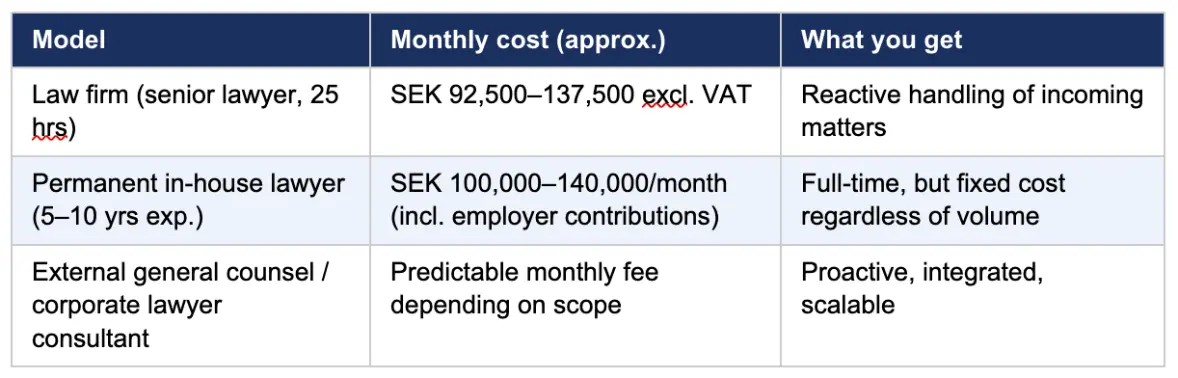
Note that law firm costs vary considerably depending on matter complexity and firm size. The figures above are benchmarks, not guarantees.
Note: The hidden cost of a law firm is not the hourly rate – it is the time you spend explaining your business over and over again for each new matter. An external general counsel who already knows your operations delivers faster and with fewer internal rounds.
Three scenarios: when does each model fit?
Scenario 1: Scale-up that quickly needs legal capacity
The company: A SaaS business with 25 employees has just closed its Series A round and now needs to move fast – new customer contracts, three hires in Germany, and a new shareholder structure to manage.
The problem: The founder has been handling legal matters personally but no longer has the time. A law firm helped with the investment agreement but is too expensive for ongoing work.
The solution: An external general counsel for 20 hours per month. She gets up to speed on the company's structure in the first week, takes over contract reviews on an ongoing basis, handles the German employment questions with support from a local partner, and monitors corporate governance standards ahead of the next round.
The outcome: The founder regains focus. Legal costs are predictable. The company is ready for the next investment round without legal red flags.
Scenario 2: Company with a complex one-off matter
The company: A mid-sized tech company is acquiring a competitor. It is the company's first M&A deal and involves SEK 80 million.
The solution: A specialist M&A law firm is the right choice for the transaction documents and due diligence process. An external general counsel coordinates internally – handles the board process, shareholder matters, and communication with all parties – and ensures that the business logic is not lost in the legal process.
The outcome: The law firm does what it does best. The external general counsel makes sure the deal makes business sense throughout.
Scenario 3: Mature company with stable legal volume
The company: A company with 120 employees and a consistently high legal need across multiple areas – employment law, commercial contracts, GDPR, and ongoing corporate matters.
The solution: A permanent General Counsel is likely more cost-effective at this volume and level of complexity. An external general counsel can complement for specialist matters or periods of particularly high demand.
The outcome: The right model for the right phase. No single solution fits all.
How do you choose?
A simple rule of thumb: if you need ongoing legal support of more than ten hours per month and are not ready to recruit a full-time lawyer, an external general counsel or legal outsourcing model is likely your best investment.
If you have a single, complex specialist matter – a transaction, a dispute, a specific regulatory question – a specialist law firm is the right tool.
Many companies combine both: an external general counsel for ongoing matters, and a law firm for the extraordinary. That gives you the best of both worlds – without paying for more than you need.
Acacia Göransson, General Counsel at LegalWorks: "What I see working best for scale-ups is an external general counsel as the primary resource, with clear relationships to a couple of specialist firms for matters that require it. Then you always know who owns the question – and you avoid coordinating five different contacts yourself.
Frequently asked questions
Can an external general counsel represent us in court?
No – court proceedings in Sweden require a qualified advokat with the right authorisation. An external general counsel handles commercial law, negotiations, and advisory work, but for disputes or litigation you need an advokat. A good external general counsel will help you select and coordinate the right litigation lawyer.
How quickly can an external general counsel get started?
Typically one to three weeks. The initial onboarding – learning the company's structure, existing contracts, and ongoing matters – normally takes a few days to a week. After that, the lawyer is fully operational. Compare that with a three-to-six-month recruitment timeline for a permanent role.
Is legal outsourcing the same as an external general counsel?
The term legal outsourcing is broader and can include everything from contract administration to full external legal support. An external general counsel is the most integrated form of legal outsourcing – a named lawyer who acts as the company's internal legal function. Routine procedural tasks can be assigned to lower-cost resources; strategy and commercial law should always be handled by an experienced lawyer.
Next steps
Not sure whether an external general counsel or a law firm is right for your company right now? LegalWorks offers an initial conversation where we go through your legal needs and give an honest recommendation – regardless of whether the answer is us or not.
Contact: acacia.goransson@legalworks.se
Read more about what an interim legal counsel is – interim-legal-counsel-guide
Legal disclaimer: This article is written for informational purposes only and does not constitute legal advice. Price examples are benchmarks based on market data and may vary. Contact a legal advisor at LegalWorks for advice tailored to your situation.




.webp)