
Interim legal counsel – what it is, when you need it, and how to choose right
An interim legal counsel is an experienced corporate or commercial lawyer who works on a consulting basis for a defined period – without being permanently employed by the company. The model gives access to senior legal expertise exactly when it is needed: during a share issue, an acquisition, a growth phase, or when the in-house lawyer is absent. In Sweden, demand is growing rapidly, particularly among scale-ups and growth companies that need professional legal support but are not yet ready to hire a full-time General Counsel.
What exactly is an interim legal counsel?
The word "interim" comes from Latin and means "in the meantime" – and that describes the model well. An interim legal counsel, also called a legal counsel for hire, an external general counsel (extern bolagsjurist), or a business lawyer on a consulting basis, steps in to fill a legal need for a defined period. This can range from three months to a couple of years.
What distinguishes an interim legal counsel from a traditional law firm is the way they work. A law firm bills per matter or per hour and handles tasks you send in. An interim legal counsel works as an integrated part of your team – on-site or remotely – and understands the business from the inside. They participate in management meetings, review contracts on an ongoing basis, give advice in real time, and act as the company's legal voice, just as an internal General Counsel would.
In Swedish contexts the role is often described as "extern bolagsjurist" or "external in-house counsel" – a term that captures the essence: you get the competence level of an in-house lawyer, without the permanent employment commitment
Acacia Göransson, General Counsel at Legal Works: The difference from a law firm is not just about price – it is about availability and understanding. An interim legal counsel learns your business, your risks, and your relationships. That makes the advice more relevant and decisions faster.
Three models for legal support – and how they differ
To understand the value of an interim legal counsel, it helps to compare the three most common ways of handling legal needs in a growth company:
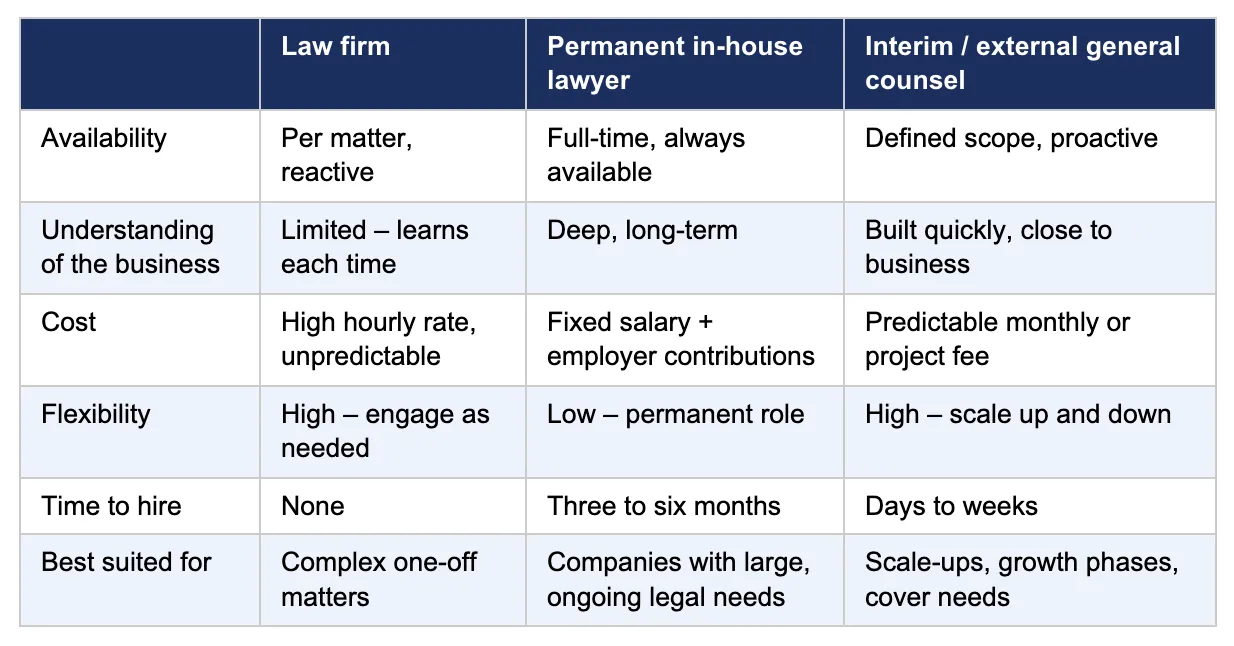
As the table shows, no model is universally best – they suit different phases and needs. But for a company growing quickly with irregular but critical legal requirements, the interim model is often the most cost-effective and flexible solution.
When does an interim legal counsel make sense?
There are a number of situations where a legal counsel for hire or external general counsel is the natural solution. Here are the most common scenarios we encounter at LegalWorks:
1. Scaling up and growth phase
You have grown out of the start-up phase and now need to handle contracts, compliance, and corporate structure in a more professional way. But a full-time General Counsel costs SEK 1–1.5 million per year in salary, and you may not be ready for that commitment. An interim legal counsel gives you the same level of competence on a flexible mandate – and can be scaled up or down as needs change.
At this stage the legal needs are often broad: commercial contracts, employment agreements, corporate governance, GDPR compliance, and sometimes preparation for an upcoming fundraise. An external general counsel who understands your business can cover all of this without you having to involve three different law firms.
2. Parental leave or leadership change
One of the clearest use cases is coverage when the company's regular lawyer or General Counsel is absent – most often on parental leave, but sometimes due to illness or a change of role. Recruiting a permanent replacement takes months. An interim legal counsel can be in place within one to three weeks and deliver from day one, because they are accustomed to quickly getting up to speed in a new business.
What distinguishes a professional interim solution from simply "managing" during the absence is continuity. A well-chosen interim legal counsel does not just handle ongoing matters – they document, structure, and hand over in a way that makes the return smooth.
3. M&A processes and fundraising
Acquisitions, mergers, and investment rounds place enormous demands on legal capacity during an intense and time-limited period. A law firm handles due diligence and transaction documents, but the legal work around an M&A process is much broader: corporate structure, board resolutions, shareholders' agreements (aktieägaravtal), regulatory clearance, and not least communication with all parties.
Bringing in an interim legal counsel to coordinate the internal legal work during an M&A process is one of the most cost-effective investments a growth company can make. The alternative – outsourcing everything to a law firm – rarely gives the same business-close understanding, and often costs considerably more.
4. Regulatory change or compliance projects
New legislation – GDPR, the AI Act, NIS2, ESG reporting – often requires a bounded project to land correctly. Bringing in a business lawyer on a consulting basis for a specific compliance assignment is more efficient than engaging a generalist firm and cheaper than recruiting a specialist lawyer for a time-limited need.
5. International expansion
You are establishing a presence in a new country or starting to sell to customers in the EU, the US, or another regulated market. Contract structures, data protection rules, corporate forms, and employment regulations all differ. An interim legal counsel with experience in international commercial law can navigate this without you having to build internal expertise from scratch.
⚠️ Note: The most common mistake we see is companies waiting too long before bringing in legal support – and then being forced to solve problems that could have been prevented. Legal advice is like insurance: cheapest when you buy it before you need it.
What does an interim legal counsel cost compared with the alternatives?
The cost question is central, and it is more complex than it first appears. Let us break down the real costs:
Law firm
A senior lawyer at a commercial law firm in Stockholm typically bills SEK 3,700–5,500 per hour excluding VAT. For a project requiring 50 hours of work, that is SEK 150,000–250,000. Often justified for complex transactions, but expensive and difficult to predict for ongoing legal work.
Permanent in-house lawyer
An experienced corporate lawyer with five to ten years of experience costs SEK 900,000–1,300,000 per year in gross salary, plus employer contributions of just over 31 per cent and other employment costs. That means a total personnel cost of SEK 1.2–1.7 million per year – every year, regardless of whether needs fluctuate. Add a three-to-six-month recruitment timeline and the risk that the person does not fit.
Interim legal counsel / external general counsel
An interim legal counsel is typically billed as a fixed monthly fee or as a package of hours per month. The model is predictable and scalable. You pay for the capacity you actually need – no more, no less. And you avoid holiday pay, sick pay, employer contributions, and notice periods.
For a company requiring 20–40 hours of legal support per month, an external general counsel is almost always more cost-effective than a permanent employee, and often better value than a law firm – with the added benefit of better continuity and deeper understanding of your business.

💡 Legal tip: Do not just calculate the hourly cost – calculate the total cost of ownership. A permanent lawyer costs money even in months when the need is low. An interim legal counsel only costs when you actually need them.
How do you choose the right interim legal counsel or provider?
Not all interim solutions are equal. Here are the most important criteria to evaluate:
Commercial breadth vs. specialist expertise
An interim legal counsel acting as external general counsel needs broad competence: commercial contracts, corporate law, employment law, and ideally experience in your industry. A specialist in IP law or tax law alone is valuable for specific projects, but not as your primary legal resource. Always ask for concrete experience from similar companies and situations.
In-house legal experience
There is an important difference between a lawyer who has always worked at a law firm and one with experience from in-house roles. An in-house-experienced lawyer understands business logic, prioritises risks pragmatically, and communicates in a way that the management team understands. They do not just tell you what the law says – they tell you what it means for your business and what you should do.
Availability and working model
How quickly can they be available? Do they work on-site, remotely, or in a hybrid model? How are urgent matters handled? An interim legal counsel who does not respond to a pressing contract question within a reasonable time is not much help. Always ask for clear answers to these questions before entering into an agreement.
Transparency on pricing
Avoid models where you do not know what you are paying until the invoice arrives. A reputable provider of corporate legal advice presents clear pricing models – either a fixed monthly fee, a package of hours, or a project price – and communicates openly about add-ons and overruns.
Cultural fit and communication style
This factor is often underestimated. An interim legal counsel who is to integrate into your team needs to fit your culture, your pace, and your way of making decisions. Always schedule an introductory meeting where you assess not only competence but also whether you enjoy working with the person.
LegalWorks' model: external in-house counsel for scale-ups
LegalWorks is a legal advisory firm specialising in acting as external general counsel and advisor for Swedish scale-ups and growth companies. Our model is built on the principle of "external in-house counsel" – we act as an integrated part of your organisation, not as an external firm you engage per matter.
We cover the full spectrum of commercial law that a growth company needs: commercial contracts and negotiations, corporate law and ownership matters, incentive programmes and options (teckningsoptioner and KPOs), GDPR and data protection, employment law, and M&A support and fundraising. You get a named legal advisor who gets to know your business, your industry, and your risks – and who is available when you need advice, not just when you send in a matter.
💡 Legal tip: Many of our clients start with a bounded assignment – such as reviewing an investment agreement or supporting a share issue – and then choose to have us as their ongoing external general counsel. It is a natural way to build trust before committing to a longer engagement.
If you would like to know more about how LegalWorks works and whether our model is right for your company, please get in touch. We are happy to explain what a collaboration could look like based on your specific needs.
Contact acacia.goransson@legalworks.se
Frequently asked questions about interim legal counsel
What is the difference between an interim legal counsel and a lawyer (advokat)?
In Sweden, an advokat is a member of the Swedish Bar Association (Sveriges advokatsamfund) and is subject to the Bar's professional rules and disciplinary framework. A jurist – interim or permanently employed – does not need to be an “advokat” to provide legal advice to a company. What matters is experience and competence. Many of the most skilled commercial lawyers on the market are not “advokater“ but have built their expertise through in-house roles at growth companies and international groups.
How long does it take to get started with an interim legal counsel?
An experienced interim legal counsel can normally be operational within one to three weeks. The initial period is spent getting to know the company's structure, existing contracts, ongoing matters, and key people. A structured onboarding – ideally starting with a documented legal health check – means you get value from the collaboration more quickly.
Can an interim legal counsel replace a law firm entirely?
For most ongoing legal needs – yes. An external general counsel covers commercial contracts, corporate law matters, employment law, GDPR, and business negotiations without you needing to engage a law firm. For specific specialist assignments, such as a complex M&A transaction, a tax dispute, or litigation, a law firm may be needed as a complement. A good interim legal counsel knows when to bring in specialist expertise – and can coordinate that process on your behalf.
How does pricing work in practice?
The most common models are a fixed monthly fee for a defined number of hours, a project price for bounded assignments, or an ongoing hourly rate. A fixed monthly fee is most common for ongoing external general counsel engagements and gives the best budget predictability. Always ask for a clear written agreement specifying what is included, how overruns are handled, and what applies in the event of early termination.
What should I look for in a contract with an interim legal counsel?
Make sure the agreement clearly covers: scope and boundaries of the assignment, confidentiality obligations, intellectual property rights to work produced, notice period and conditions for early termination, and any non-compete provisions after the engagement ends. Always insist on a written assignment agreement – not just a confirmation by email.
Does the interim model work for smaller companies too?
Absolutely. An external general counsel on a part-time basis – for example ten to twenty hours per month – is often more cost-effective and valuable for a company with 10–50 employees than engaging a law firm on an ad hoc basis. You get continuity, business-close advice, and a legal voice in the management team without paying for a full-time position.
Summary
An interim legal counsel – or external general counsel (extern bolagsjurist) – is a flexible, cost-effective, and business-close solution for growth companies that need professional legal support without recruiting a full-time lawyer. The model fits particularly well during scaling phases, M&A processes, parental leave cover, and regulatory projects. The right provider gives you not just legal security – but a strategic partner who understands your business and helps you make better decisions, faster. Contact LegalWorks to discuss how an external general counsel can support your company: acacia.goransson@legalworks.se
More related articles: External general counsels vs Law firm - which is right for your company?
Legal disclaimer: This article is written for informational purposes only and does not constitute legal advice. The content reflects the regulatory framework and market practice as of the stated publication date. Please contact a legal advisor at LegalWorks for advice tailored to your specific situation.



.webp)
.webp)