Legal Operations – how modern companies streamline their legal function
Legal Operations – or legal ops – is the discipline that combines legal expertise with process development, technology, and data-driven governance to make a company's legal function more efficient and predictable. It is not about replacing lawyers with algorithms, but about freeing up legal capacity for the questions that genuinely require human judgement – and automating the rest.
Why legal operations is a growing discipline
Legal operations is one of the fastest-growing areas in commercial law. The drivers are familiar to most CEOs and CFOs: legal costs are rising, contract volumes are increasing with digitalisation, and management increasingly expects clearer reporting on legal risks and expenditure.
In Sweden, interest in legal ops and legal tech has accelerated markedly in recent years. LegalWorks founded Nordic Legal Tech Day – the Nordic region's leading conference on law and technology – as a direct response to this: a recognition that lawyers and technologists need to meet to drive change forward. It is an area we follow closely and actively integrate into our advisory work.
Acacia Göransson, General Counsel at LegalWorks: "Legal ops is not an IT project. It is a strategic decision about how law should function in the organisation. Companies that succeed combine legal expertise with process understanding and the right technology – in that order.
What does legal operations include?
Legal ops is a broad umbrella term. In practice it is usually broken down into five main areas:
1. Process development and standardisation
The first step in legal ops is almost always to map how legal work actually flows today. Where do bottlenecks occur? Which matters recur? Where do lawyers spend the most time on work with low strategic value? The answers lead to standardised processes: template agreements, approval workflows, checklists, and decision support tools that make handling faster and more consistent.
2. Contract management and CLM systems
Contracts are at the core of most legal functions. Contract Lifecycle Management (CLM) covers the systematic handling of the entire contract process: from negotiation and signing through to ongoing monitoring of renewal dates, options, and obligations. Modern CLM systems such as Ironclad, Juro, or Contractbook make it possible to manage hundreds of contracts without drowning in spreadsheets and email threads.
For a growth company with 50–200 employees, a well-implemented CLM system is often the single investment with the greatest impact on the legal function's productivity. The cost is predictable, implementation is fast, and the outcome – control over the contract portfolio – is immediately measurable.
3. Automation and legal tech
Legal automation means letting technology handle repetitive, rule-based tasks: generating standard contracts from parameters, sending reminders about expiry dates, classifying incoming contract requests, and flagging clauses that deviate from company policy. Legal tech tools in this area range from simple document generators to AI-based contract analysis platforms.
An important distinction: legal automation does not replace legal expertise in complex matters. It frees that expertise for the right tasks.
4. Data and governance
A mature legal ops function measures its own performance. How long does it take to process a standard contract? Which contract types cause the most disputes? Where do the greatest legal risks arise in the business? Data-driven law makes it possible to report to the management team in a way that builds credibility and enables resource allocation based on actual needs rather than estimates.
5. Vendor management
For companies that engage external legal providers – law firms, interim legal counsel, specialists – managing those relationships is a central part of legal ops. This means clear scope-of-work definitions, budget control, quality evaluation, and ensuring the right provider is used for the right type of matter.
Legal ops in practice: three maturity levels
Not all companies are at the same point in their legal ops journey. Here is a simple model for understanding where you are and where you can get to:
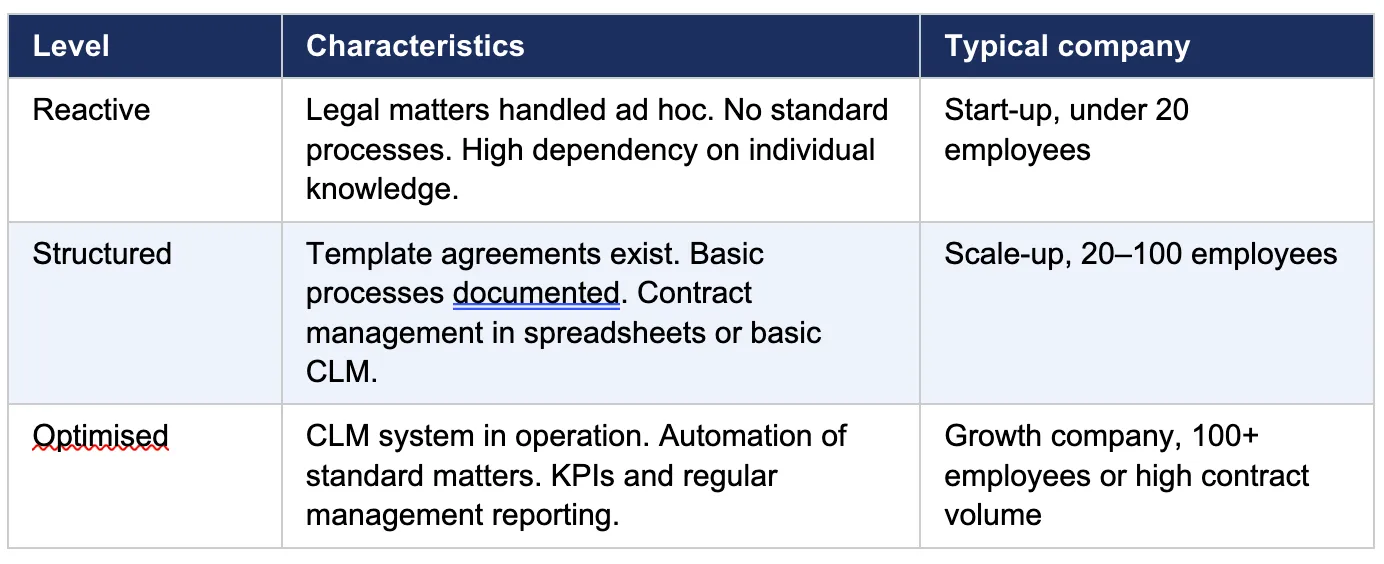
Most growth companies we encounter are in the transition between reactive and structured. This is where legal ops delivers the greatest impact per invested pound – and where we typically start when working with LegalWorks clients.
Acacia Göransson, General Counsel at LegalWorks: "The most common mistake is starting with the technology. Do not buy a CLM system before you know which processes it needs to support. Map the workflow first – the technology is then relatively straightforward to layer on top.
How does legal ops connect to your external legal function?
A common misconception is that legal ops is only relevant for companies with a large internal legal department. It is not. An external general counsel (extern bolagsjurist) – or an external legal advisory firm like LegalWorks – can drive legal ops work just as effectively as an internal function, and often more cost-effectively.
At LegalWorks, we combine legal advice with active legal ops work: we help clients implement CLM systems, design contract approval workflows, build template libraries, and set up KPIs for the legal function. This is a natural part of what it means to be your external general counsel – not a separate consulting project.
Our background in Nordic Legal Tech Day – which we founded to build a Nordic community around law and technology – gives us a distinctive position. We follow the legal tech market more closely than most, and we can help you choose the right tools without getting caught up in hype around technology solutions that rarely deliver what they promise.
Getting started with legal ops: four concrete steps
- Conduct a legal health check. Map your existing contracts, processes, and risks. Identify where time and money are leaking today.
- Standardise the repeatable. Start with the three to five contract types you handle most – NDAs, consulting agreements, customer contracts. Build templates and approval workflows.
- Choose a CLM tool that fits your volume. You do not need the most expensive system. For most scale-ups, a mid-range tool – implemented correctly – is sufficient.
- Measure and report. Set up three to five simple KPIs: processing time per contract type, number of open matters, cost per legal matter. Present them to the management team quarterly.
Frequently asked questions about legal operations
Do we need a full-time Legal Operations Manager?
Not necessarily. For companies under 150 employees, legal ops work can often be driven by an external general counsel with the right competence, combined with straightforward digital tools. A dedicated Legal Operations Manager becomes relevant when contract volumes and complexity are high enough to justify a full-time role – typically at 200+ employees or very high contract throughput.
Which CLM system should we choose?
It depends on your volume, your processes, and your budget. Popular options for Swedish growth companies include Contractbook (Nordic, easy to get started with), Juro (strong for commercial contracts), and Ironclad (more advanced, suited to companies with complex contract handling). Avoid choosing a system based on feature lists – choose based on how well the system fits your actual workflows.
How long does it take to see results from legal ops work?
Quick wins – such as standardised template agreements and digital signing workflows – can be implemented in two to four weeks and deliver immediate results. More structural changes, such as implementing a CLM system and KPI reporting, typically take three to six months to establish fully. Expect it to take a year before legal ops is embedded in the organisation's muscle memory.
Is legal ops relevant for us if we do not have an internal lawyer?
Yes – and perhaps especially relevant. Companies without an internal legal function often have the most chaotic legal processes and the most to gain from structuring. An external general counsel who also drives legal ops work gives you double value: legal advice and process efficiency in one.
Next steps
Would you like to know where your company stands in its legal ops maturity – and what would have the greatest impact to change? LegalWorks offers a legal health check that maps your legal processes, contract management, and risks, and provides concrete recommendations for the next steps.
Contact:
acacia.goransson@legalworks.se
More related articles
External-general-counsel-vs-law-firm
Legal disclaimer: This article is written for informational purposes only and does not constitute legal advice. Tools and systems mentioned are examples based on a market