Legal advice for scale-ups – what you need in place and when
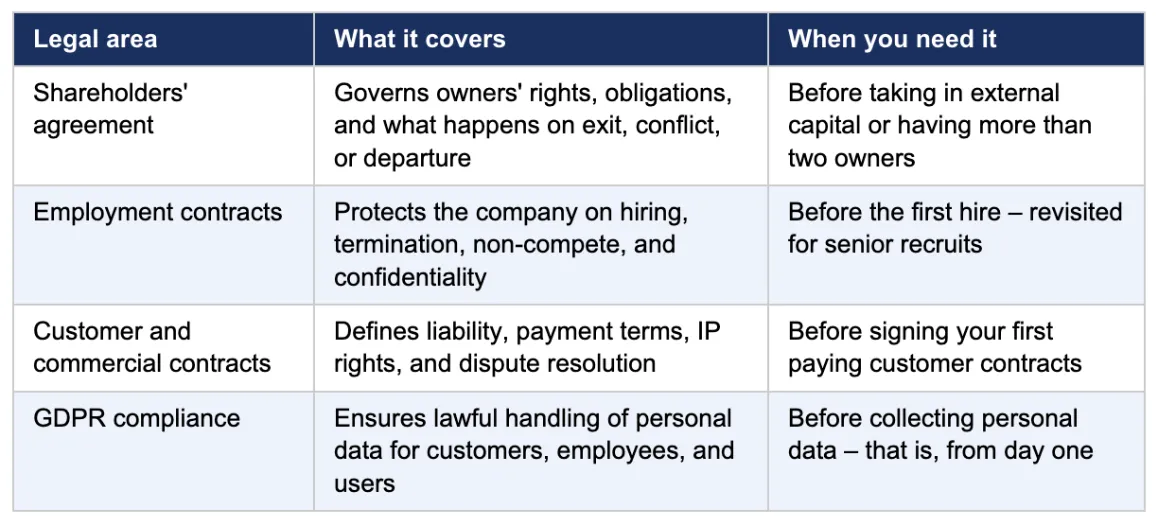
Legal advice for scale-ups is about having the right protections in place at the right time – not about solving every problem at once. For a company in its growth phase with zero to fifty employees, there are four legal foundations that need to be in place before the acute situations arise: a shareholders' agreement, employment contracts, customer contracts, and GDPR compliance. This guide explains what each pillar involves, when you need it, and what happens if you wait too long.
Why legal matters are especially critical in the growth phase
The growth phase is when most legal mistakes are made – and when their consequences are greatest. The paradox is familiar: the faster the company grows, the more business development is prioritised over legal structure. But it is precisely in that phase that ownership conflicts arise, key employees leave without adequate protection, customer contracts lack critical clauses, and GDPR gaps create regulatory risk.
We see the same pattern recurring in growth companies: legal matters are handled reactively until something goes wrong – an ownership dispute, a key person taking clients with them when they leave, an investor making demands you cannot meet. The cost of fixing these problems after the fact is almost always several times higher than having had the right structure in place from the start.
Acacia Göransson, legal advisor at LegalWorks: "The legal work that delivers the most value for a scale-up is not the work that solves acute problems – it is the work that prevents them. And preventive law is always cheaper than remedial law.
The legal checklist for scale-ups: four foundations
1. Shareholders' agreement – the legal cornerstone
A shareholders' agreement (SHA, or aktieägaravtal in Swedish) is the most important legal document a growth company can have. It governs what happens in situations that the articles of association do not cover: what happens if a founder wants to leave? What happens if you disagree on strategic direction? What happens if an investor wants to sell and the rest do not?
Without a shareholders' agreement, these questions are resolved either by the Swedish Companies Act (aktiebolagslagen) – which rarely gives the answer you want – or by the courts, which is expensive and slow. The most common clauses missing from the start-up shareholders' agreements we review are: founder vesting provisions, tag-along and drag-along rights, buy-out rights on exit, and decision thresholds for strategic matters.
⚠️ Note: A shareholders' agreement needs to be in place before you bring in an external investor – not as part of the investment process. An investor negotiating your SHA has different interests from those you founders have among yourselves.
2. Employment contracts – protect the company and the employee
Many growth companies use generic employment contracts from the internet or employer association standard templates. This is sufficient for straightforward administrative roles – but not for senior hires, key people, or employees who handle business-critical information.
A well-tailored employment contract for a scale-up should cover: a non-compete clause and customer protection clause adapted to the role, confidentiality obligations covering trade secrets and technology, an IP assignment clause ensuring that what the employee creates belongs to the company, and clear provisions for what applies on termination. Under Sweden's Employment Protection Act (lagen om anställningsskydd, LAS), it is also important to understand the implications of your employment forms – the difference between probationary employment, fixed-term employment, and permanent employment has significant practical consequences.
3. Customer and commercial contracts – define the rules of the game
The customer contract is often the last legal document a growth company prioritises – and the first to cause problems. Common shortcomings: liability caps that are non-existent or unrealistic, payment terms with no consequences for late payment, unclear ownership of intellectual property in what is produced, and dispute resolution clauses that point to the wrong forum or are missing entirely.
For SaaS and tech companies, data processing agreements (DPAs) with customers who handle personal data through your platform are also required. These are a GDPR requirement – not a choice.
4. GDPR – not a one-off project but an ongoing obligation
GDPR compliance for start-ups and scale-ups comes down to three things: knowing which personal data you collect and why, having the right agreements with the suppliers who process data on your behalf, and having an internal process for handling data subject requests and potential incidents.
The most common mistake we see is treating GDPR as a one-off project – a policy written once and then forgotten. In practice, GDPR is an ongoing obligation that needs to be integrated into how you onboard customers, manage employees, and select technology solutions. A data protection review at 20–25 employees is a good starting point if you have not done one already.
Acacia Göransson, General Counsel at LegalWorks: "GDPR for start-ups does not need to be complicated. The most important thing is knowing what you collect, why you collect it, and having agreements with your sub-processors. Everything else follows naturally from that.
When should you bring in legal advice?
A question we frequently hear is: "Are we too early to need legal help?" The answer is almost always no. Here are the rules of thumb:
- Day one: Make sure the company's IP belongs to the company – not the founders personally. This is fixed with a straightforward agreement.
- Before the first external investment: Shareholders' agreement in place, company structure reviewed, articles of association updated.
- Before the first hire: Employment contract with the right clauses for your industry and needs.
- Before handling customer data: GDPR foundations in place – privacy policy, processing register, DPA template.
- Before Series A or later rounds: Full legal health check. Investors conduct due diligence – be ready.
Companies that bring in legal advice early generally spend less on law in total – because they avoid solving problems that should never have arisen.
Frequently asked questions
Do we need a shareholders' agreement if there are only two of us?
Yes – possibly even more so. Two founders without a shareholders' agreement have no agreed process for what happens if one of them wants to leave, becomes ill, or does not contribute as expected. Most ownership disputes we encounter arise in two-founder companies. A well-written shareholders' agreement removes most sources of conflict before they arise.
Can we use standard templates for employment contracts?
For straightforward administrative roles – often yes. For senior roles, technical key persons, or employees with access to trade secrets – no. Non-compete and IP assignment clauses must be correctly formulated to be legally valid in Sweden. A poorly drafted non-compete clause is entirely unenforceable, which can be costly if a key person leaves and starts a competing business.
How much does legal advice cost for a scale-up?
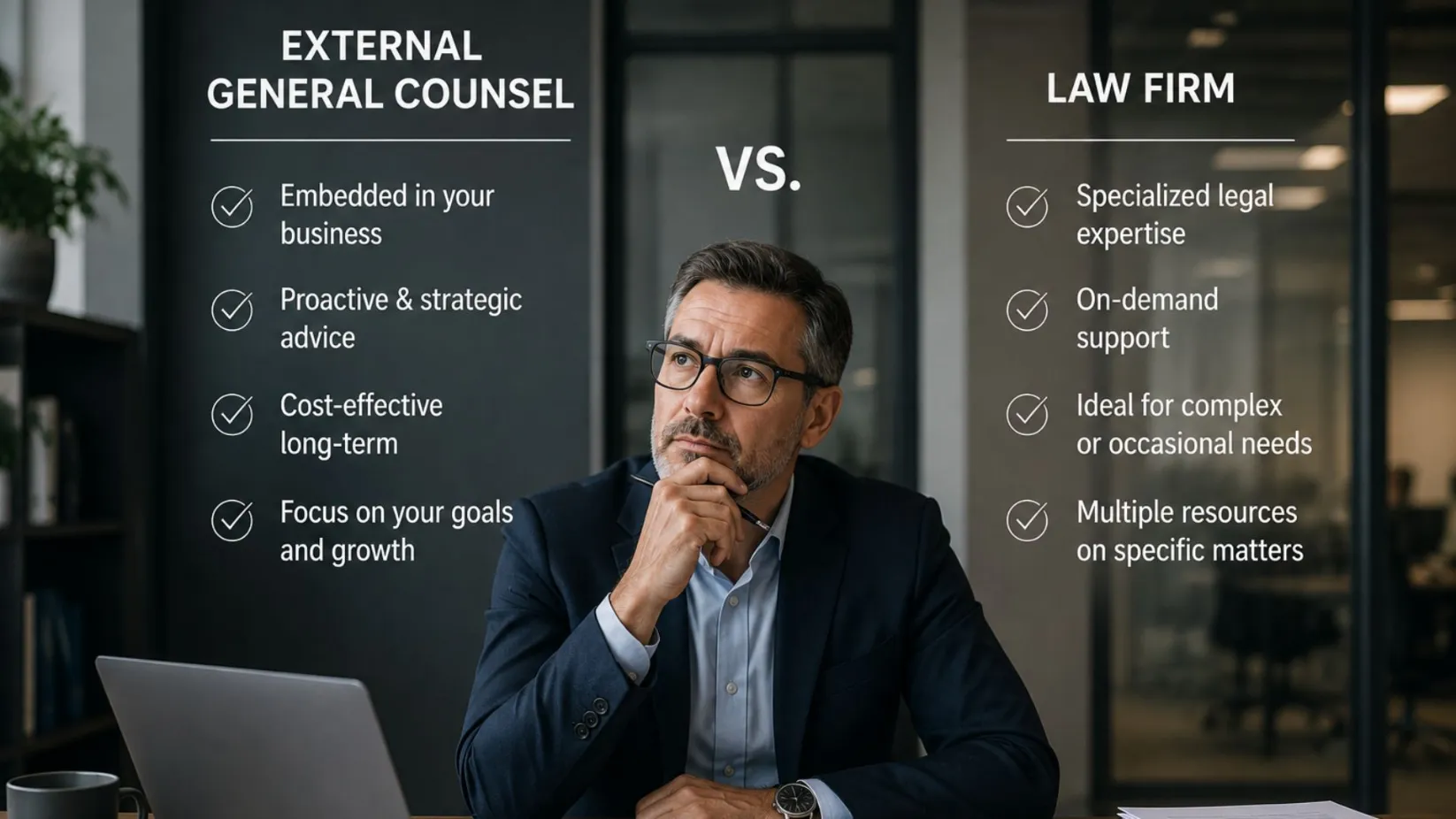
It varies considerably depending on the model. An external general counsel on a part-time mandate – for example ten to twenty hours per month – gives you ongoing legal coverage at a predictable monthly cost. For most scale-ups this is more cost-effective than engaging a law firm per matter, and considerably less expensive than recruiting a full-time lawyer. Contact LegalWorks to discuss what suits your company.
Next steps
Would you like to know what your company is missing legally – and what is most urgent to address? LegalWorks offers a legal health check for growth companies that gives you a clear picture of the current situation and concrete next steps.
Contact:
acacia.goransson@legalworks.se
Read more about what an external general counsel costs – external-general-counsel-vs-law-firm